Research Interests

I study computational astrophysics, developing new numerical schemes to better understand the formation of rocky planets and brown dwarf binaries.

Latest Work

Brown Dwarf Formation via Circumstellar Disk Encounters

Brown dwarfs are objects intermediate between stars and planets, with masses of about 0.01–0.08 M☉, and their formation mechanism is still not fully understood. While several scenarios have been proposed, no unified picture has yet been established. In this study, we explore a formation scenario in which close encounters between circumstellar discs induce the formation of brown dwarfs via a gravitationally unstable filamentary “bridge” connecting the discs. Using Smoothed Particle Hydrodynamics, we simulate encounters between realistic circumstellar discs and investigate the physical conditions under which such bridge structures form. This work aims to clarify the role of disc–disc interactions in brown dwarf formation and to place this mechanism within the broader context of star and sub-stellar object formation.
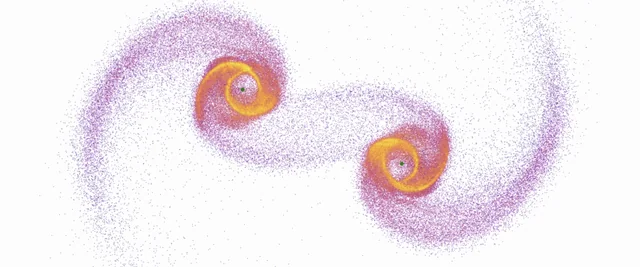
Simulation render for brown dwarf formation study

A New Extension of SPH to Elastic Dynamics

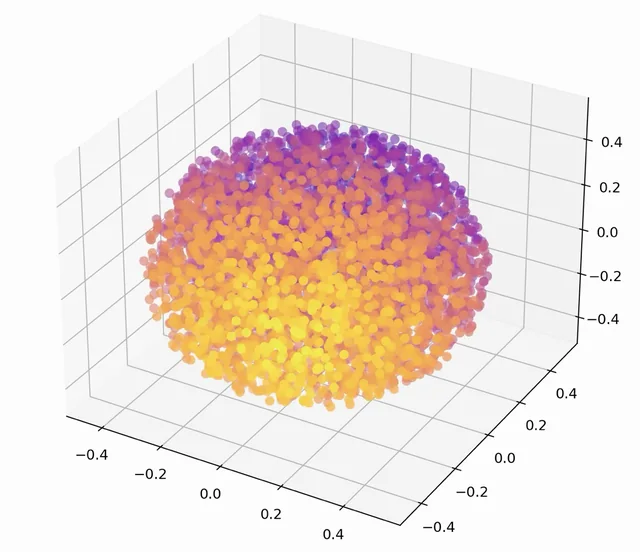
Rocky planets formed through repeated collisions of planetesimals, but Earth’s early record was largely erased by a magma ocean, leaving asteroids as the primary archives of rocky-planet assembly. Observations show a wide diversity of asteroid shapes, including spinning-top bodies such as Ryugu and Bennu, whose formation mechanisms remain unclear. Existing impact-simulation methods are computationally expensive and often fail to conserve angular momentum. We have developed a new Lagrangian method based on two central inter-particle forces that encode deviatoric stress without evolving the full stress tensor, ensuring exact conservation of total angular momentum at reduced computational cost. With calibrated models for damage, fragmentation, and friction, this method enables efficient and physically consistent studies of asteroid formation and shape evolution, as well as other rocky-planet processes.

Visualization for SPH elastic dynamics project